How to Write a Dunning Letter: 3 Templates for Overdue Invoices


What is a dunning letter?
A dunning letter is a written request for payment of an overdue amount. A business may send it by email or as a formal letter to remind a customer what remains unpaid and explain the next step.
A useful dunning notice makes action easy: it identifies the invoice, confirms the unpaid amount and original due date, provides a payment route, and names someone who can answer questions.
It also leaves room for the facts. A late invoice may involve a payment in transit, a missing document, or a dispute. Clear follow-up should surface the obstacle instead of simply repeating a demand.
Dunning letter vs. payment reminder vs. statement
A payment reminder can arrive before an invoice is due. A dunning letter concerns an overdue amount. A statement summarizes account activity or open balances and may contain both current and overdue invoices.
Keep those purposes clear. If an account has $8,000 outstanding but only $2,000 past due, do not describe the full $8,000 as overdue. See outstanding balance meaning for a worked example.
The terminology matters less to a customer than an accurate amount and a clear request. Internally, consistent definitions help the team send the right communication.
Before you send a dunning notice
Check the due date and terms, recent payments, credits, disputes, and any existing promise to pay. Confirm the recipient actually handles AP for the account.
If the customer says payment has already been sent, request the date, method, amount, and remittance reference. Verify receipt and allocation before repeating the demand. If a specific invoice is disputed, assign an owner and follow your policy for collecting the undisputed portion.
These checks prevent avoidable back-and-forth. They also stop several collectors from making overlapping requests.
What to include
Use an identifiable sender and a subject line containing the invoice number. In the message, state the amount still unpaid, the original due date, and the action requested now.
Include a verified payment link or established payment instructions, a way to obtain the invoice, and a contact for questions or remittance details. If you ask for a response by a particular date, distinguish that response date from the original invoice due date.
Avoid adding generic late fees, threatening an automatic credit hold, or promising legal action. Any consequence should match the agreement, applicable requirements, and an approved decision.
Three original dunning letter templates
These examples concern ordinary B2B invoices. Replace the brackets, verify every balance and date, and adapt the wording to the account's actual status. Payment links should use your established, trusted payment route.
Template 1: First overdue notice
Subject: Invoice [invoice number]: payment follow-up
Hello [AP contact],
Our records show [amount] remains unpaid on invoice [invoice number], originally due [due date].
Please arrange payment through [verified payment link or established instructions]. You can find the invoice at [invoice link or attachment].
If payment is already on its way, please send the payment date and remittance reference so we can check our records. If anything is preventing payment, reply here or contact [name and contact details].
Thank you,
[Name]
[Company]
Template 2: Follow-up asking for a payment commitment
Subject: Payment date requested: invoice [invoice number]
Hello [AP contact],
We are following up on our message of [previous contact date]. Invoice [invoice number] still has an unpaid balance of [amount]; the original due date was [due date].
Please reply by [response date] with the date you expect to pay, or arrange payment through [verified payment link or established instructions].
If you dispute part of this amount, please identify the item and send the supporting details to [contact]. We will assign the issue for review and confirm the next step with you.
Regards,
[Name]
[Company]
Template 3: Final routine reminder before account review
Subject: Response needed by [date]: overdue invoice [invoice number]
Hello [AP contact],
Invoice [invoice number], originally due [due date], has a remaining unpaid balance of [amount]. Our previous contacts were on [dates].
Please arrange payment through [verified payment link or established instructions], or contact [name] by [response date] to confirm the payment status or explain the unresolved issue.
If we do not receive payment or a response by that date, we will refer the account to [approved internal role] for review of the next steps under our agreement.
If you have already paid, please send the remittance details so we can reconcile the account.
Regards,
[Name]
[Company]
Use the final template only when an internal review is actually planned. It does not itself announce a legal demand, service suspension, or third-party collection action.
Build a cadence around account status
There is no universal schedule for every customer. As an illustrative starting point, a team might check the account shortly after the due date, request a commitment after an unanswered reminder, and route continued nonresponse for review.
Choose the intervals based on terms, exposure, payment history, and the reason for delay. A large disputed invoice may need a direct conversation before another automated message. A customer with a documented payment commitment needs follow-up tied to that commitment.
Keep a named owner, next action date, and contact history. Update the workflow when a payment, dispute, or new agreement changes the facts. More reminders are not automatically better collections.
Measure outcomes beyond messages sent
Count invoices resolved through payment, commitments kept, and time spent clearing disputes. Track balances moving into older aging buckets and DSO alongside those measures.
Keep write-offs and credits separate from cash recovered. Closing an invoice does not necessarily mean it was paid. If collectibility deteriorates, involve the responsible credit or accounting owner rather than using increasingly forceful wording as a substitute for assessment. See bad debt expense and write-offs.
Put your dunning cadence to work with Payra Custom Notifications
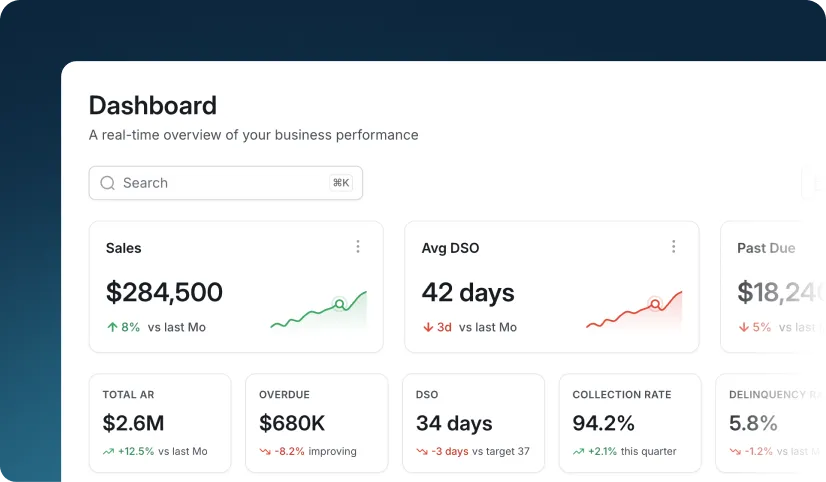
Writing a clear dunning letter is one part of the process. Sending the right follow-up consistently is the other. Payra Custom Notifications lets you configure reminder cadences for all customers, customer groups, or individual accounts.
Reminders can go out before, on, or after the due date by email and text, with a payment link included. Once an invoice is paid, its reminder sequence stops automatically. Notification history is tracked by customer and invoice, so your team can see what has already been sent before reaching out.
For overdue accounts that need attention, Payra can also send an escalation report to your accounting team. That gives routine reminders a defined path to human follow-up when an account needs review.
Consistent reminders and a direct payment link can help reduce the avoidable delays that keep invoices outstanding. Payra Custom Notifications handles routine follow-up, while escalation reports help your team focus on overdue accounts that need personal attention. When these steps help customers pay sooner, they can support a lower days sales outstanding (DSO). Track DSO alongside past-due balances to evaluate progress; results also depend on payment terms, disputes, and customer payment behavior.
Explore Payra Custom Notifications to see how configurable reminders can support your dunning process and reduce the work of sending one-off follow-ups.
Frequently asked questions
Can a dunning letter be an email?
Yes. Use the channel appropriate to the account, agreement, and communication requirements.
Should every notice sound more severe?
No. The next message should reflect the facts. A documented dispute needs resolution; a broken promise needs follow-up.
Should I add a late fee?
Only when it is permitted, correctly calculated, and approved under the relevant agreement and requirements. The templates intentionally do not assume a fee.